Radon Mitigation in Older Minneapolis Basements
Radon mitigation in a Minneapolis house from before the Second World War starts with a basement that was never designed to stop soil gas. About 43% of the city's homes were built in 1939 or earlier (U.S. Census Bureau, 2020–2024), and their basements set the shape of the system.
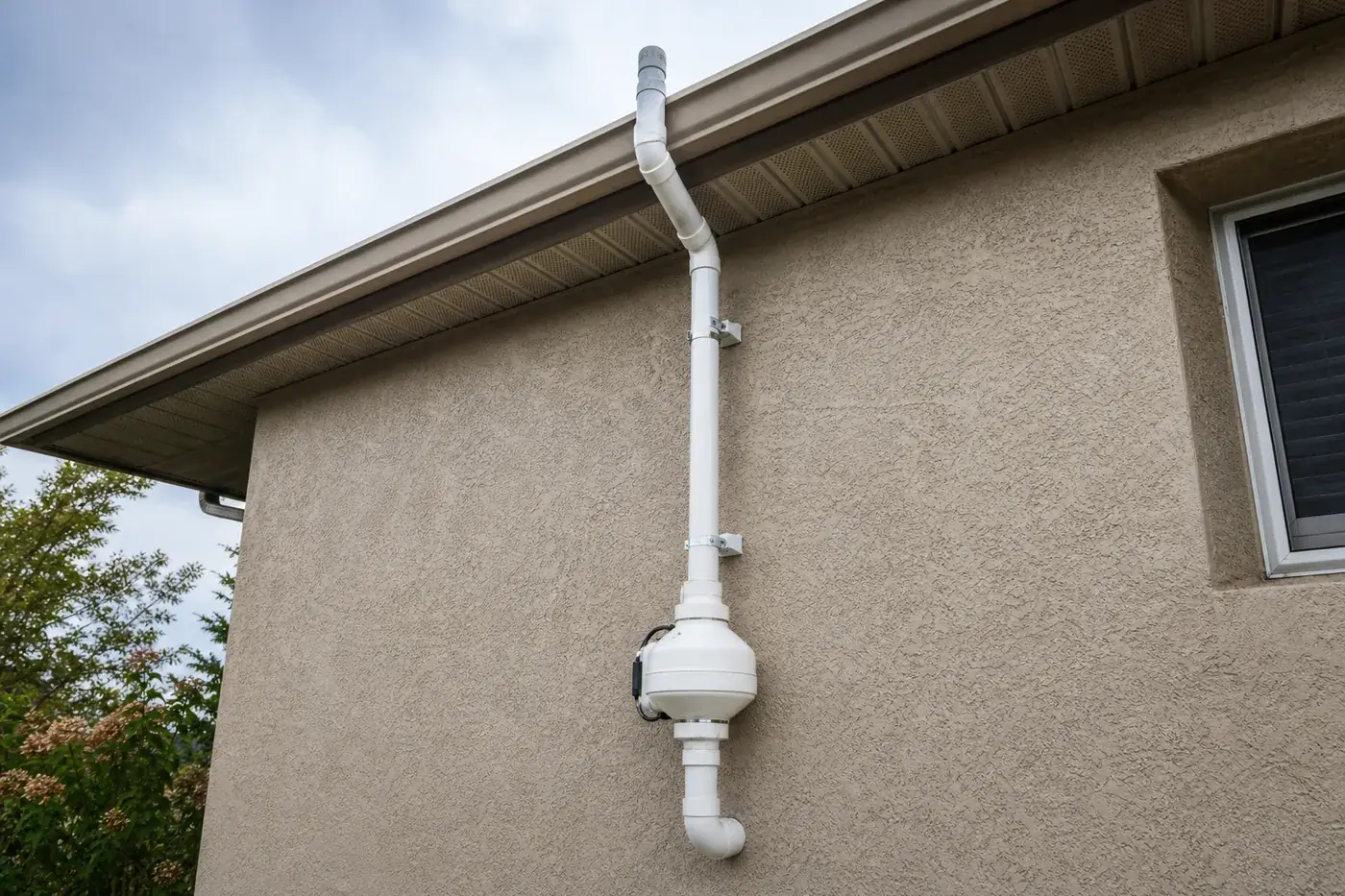
Most older Minneapolis basements get sub-slab suction: a pipe sealed through the floor, a fan outside the living space, and an exhaust above the roof edge. Drain tile suction suits homes with an interior drain loop and sump. MDH gives $1,500–$3,000 as a general Minnesota cost for a system.
What makes an old basement harder to mitigate?
Three things set older basements apart. The walls are often stone, brick or hollow block rather than poured concrete, with mortar joints and open cores that let soil gas through. The floor may be thin and laid straight on native soil, without the 4 inches of clean gravel that Minnesota's radon code now requires under new slabs (Minnesota Rules 1303.2401); that rule only reached new homes in 2009. And decades of changes leave openings: old floor drains, patched trenches, a sump basket with no lid. MDH lists cracks in the slab, the floor-wall joint, an open sump pit and crawl spaces as the usual ways radon gets in.
How is the suction point chosen?
By testing the floor before cutting it. MDH suggests asking whether the professional will run diagnostics to choose the suction point and size the pipe and fan. In practice that means drilling small test holes, pulling a vacuum at one and measuring how far it reaches at the others. Loose fill lets one suction point cover a whole basement; dense soil or interior footings can call for two or more points joined into one pipe. A small pit is dug out under the suction hole so air can collect, and cracks and openings are sealed, which MDH says makes the system work more efficiently.
What about the sump, the drain tile and block walls?
Many Minneapolis basements have a sump basket, and some have a drain tile loop feeding it. MDH names drain tile suction as one of the three common Minnesota systems: the pipe taps the tile, the basket gets a sealed cover, and the loop becomes the collection path. Left open, the same basket is a direct entry point. Hollow block walls carry soil gas through their cores; Bob Vila (2022) calls block-wall suction more expensive and less effective than sub-slab suction, so it is usually an add-on. Stone walls cannot be depressurized the same way, and the usual approach is sealing the worst joints and relying on suction under the floor. Ask the specialist how they plan to handle your walls.
Where can the fan and pipe go on an older house?
- Fan: outside, in the attic or in a garage. MDH says never in or below a livable space, which rules out the basement.
- Pipe: inside or outside the house. A run through a closet to the attic keeps it off a stucco or brick facade; an outside run is usually simpler.
- Exhaust: above the edge of the roof, at least 10 feet above the ground and 10 feet from windows, doors and openings unless it ends at least 2 feet above them (MDH).
- Additions: a dirt-floored crawl space or porch needs sealed plastic and its own suction, tied into the main pipe.
- Paperwork: an MDH tag on the finished system, written operating instructions, and a retest after the fan has run at least 24 hours.
Prices for each design are in what radon mitigation costs in Minneapolis.
Questions homeowners ask
Can a radon system use the sump basket in my basement?
Often, yes. MDH lists drain tile suction, where the radon pipe taps the drain tile and the sump basket gets a sealed cover, among the three most common Minnesota systems. The pump still has to work, so the cover must allow service. Whether the tile loop reaches far enough to pull suction under the whole floor is what diagnostics decide.
What is going on with radon at your house?
A test number, a vent pipe with no fan, a gauge that reads level, a closing date: any one of these is enough to start. One independent radon mitigation specialist serving Minneapolis reads it and replies.