State guidance and national guides, each dated
Radon Mitigation Cost in Minneapolis: Minnesota and National Figures
Radon mitigation cost in Minneapolis has an unusual benchmark: the Minnesota Department of Health publishes a general price range and warns against bids that look too cheap. Under it sit national figures from Thumbtack, Fixr and Bob Vila, each with its year, so a written proposal can be read against both.
MDH says a Minnesota radon mitigation system generally costs $1,500–$3,000 and warns against rates under $1,000. Thumbtack's 2026 national data run lower, $748–$1,529, with most paying about $1,071. Bob Vila (2022) lists block-wall and crawl space systems up to $3,000.
Radon mitigation cost by system: Minnesota and national figures
| What is priced | Range | Source, year | Where a Minneapolis house fits |
|---|---|---|---|
| Mitigation system, general Minnesota range | $1,500–$3,000 | MDH, 2024 | The state's own figure; MDH cautions against offers under $1,000 |
| Typical installed system, national | $748–$1,529; typical payment near $1,071 | Thumbtack, 2026 | One suction point in an open, unfinished basement |
| Fan-driven suction under the slab | $500–$2,500 | Fixr, 2025 | Older floors on dense soil may need extra suction points |
| Suction through the drain tile loop | $800 to $1,700 and up | Bob Vila, 2022 | Basements with an interior drain tile loop |
| Sealed sump suction | $800–$2,500 | Bob Vila, 2022 | The basket gets an airtight cover the pump can still be serviced through |
| Suction inside hollow block walls | $1,500–$3,000 | Bob Vila, 2022 | Rarely alone; paired with suction under the floor |
| Crawl space sub-membrane | $800–$3,000 | Bob Vila, 2022 | Crawl space additions and porches behind an older basement |
| Sealing a dirt floor before suction | $300–$1,000 extra | Fixr, 2025 | Dirt-floored crawl areas and old root cellars |
| Radon fan, part only | $100–$300 or more | Bob Vila, 2022 | Activating a passive pipe, or replacing a worn fan |
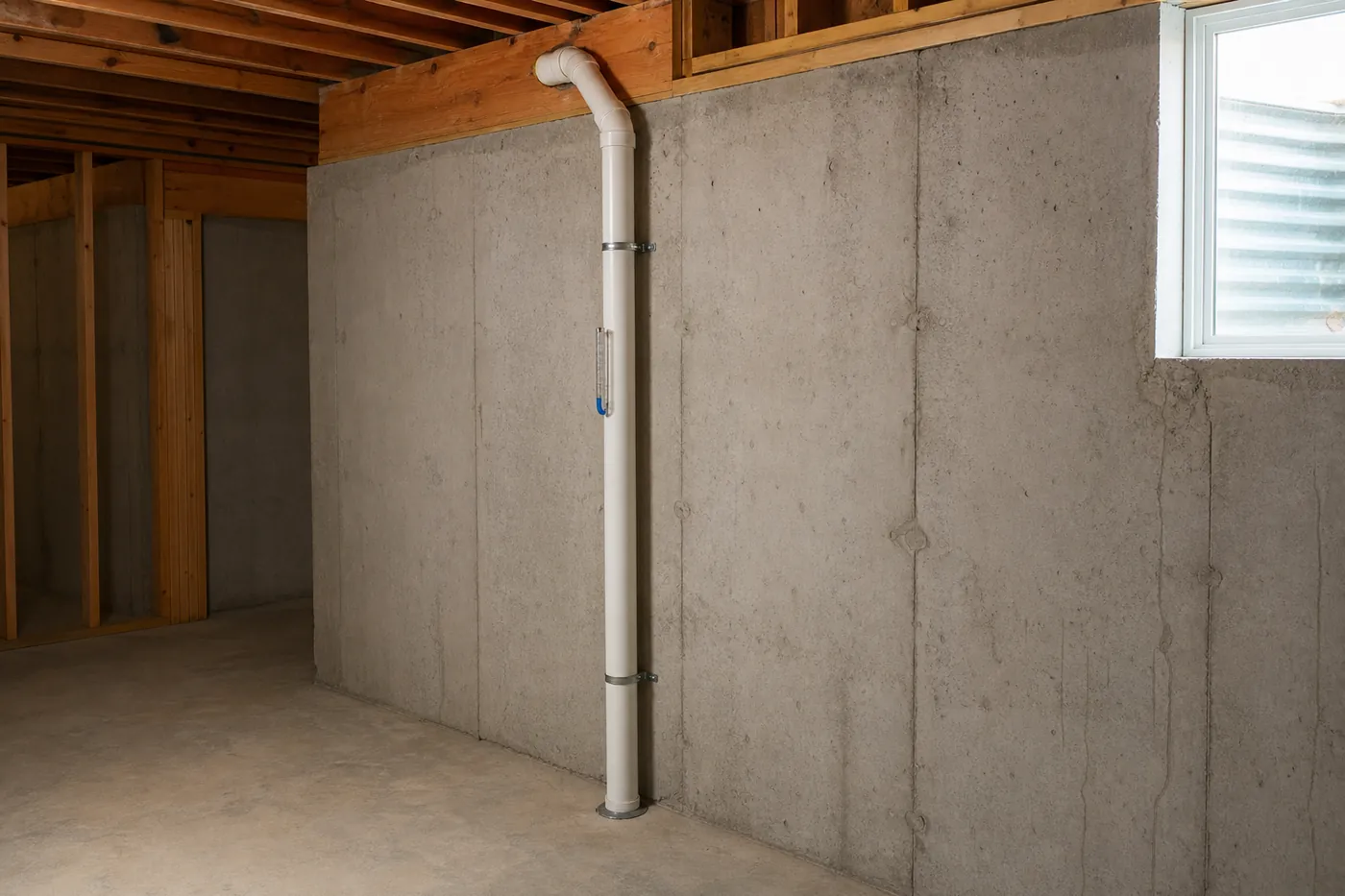
What drives radon mitigation cost in a Minneapolis house?
- The age of the basement. 43% of Minneapolis homes were built in 1939 or earlier (U.S. Census Bureau, 2020–2024). Those floors predate the 4 inches of clean gravel that Minnesota's radon code now puts under new slabs (Minnesota Rules 1303.2401), so air may move poorly beneath them and one suction point may not reach the whole floor.
- More than one foundation. A basement with a crawl space addition or a slab porch may need suction under each part. MDH asks testers to check each foundation type during a sale for the same reason.
- The pipe route. MDH allows the pipe inside or outside. An interior run through a closet to the attic means more carpentry; an exterior run is simpler but hangs on the siding. Either way it must end above the roof edge, at least 10 feet above ground and 10 feet from windows, doors and openings unless it ends 2 feet above them.
- Wiring. MDH says most installs need electrical work and an electrical permit, and a contractor doing that work must be licensed.
- A passive pipe already in place. In a home built since 2009, the job may be a fan, a gauge or alarm, and wiring.
What does Minnesota's health department say about price?
MDH is unusually direct. It gives $1,500 to $3,000 as a general cost and tells homeowners to avoid unlicensed installers and rates under $1,000, which it says often mean poor workmanship and materials and a system that may not work. National averages from the guides above can sit below $1,000, so a low bid is not proof of a bad one, but it is a reason to ask what it leaves out. MDH's other buying advice:
- get a proposal only after the professional has walked through the house, never sight unseen;
- ask for a firm price with no hidden fees for later work;
- ask whether diagnostics will set the suction point and the pipe and fan size;
- hold back full payment until a valid test shows the level has dropped.
What does a radon fan cost to run through a Minnesota winter?
Estimates differ widely. MDH's radon-resistant construction page puts an active system at slightly more than $14 a year to operate; Bob Vila (2022) gives $30–$300 a year, depending on the fan and power rates. Fans also wear out, and Bob Vila prices a replacement at $100–$300 or more, with a U-tube gauge at $10–$20. MDH recommends retesting every 2 to 5 years: Fixr (2025) lists short-term kits at $20–$350, and MDH notes Minnesota residents get a discount on Air Chek kits.
Is there help paying for a radon system?
Sometimes. MDH points to Minnesota Housing's home improvement programs: the Fix-Up loan, a low-interest fixed-rate loan where a radon system can be paired with other projects to reach the loan minimum, and the Rehabilitation and Emergency and Accessibility loan programs for lower-income owners. MDH also suggests asking city and county housing agencies about grants or low-interest loans. Eligibility depends on income, location and available funding.
Cost questions
Why does MDH warn about radon bids under $1,000?
Because, in MDH's words, very low quotes are often too good to be true. Its guidance says they can leave a homeowner with poor workmanship, poor materials and a system that may not work. National averages can dip below $1,000, so ask any low bidder exactly what diagnostics, sealing, wiring and retesting the price includes.
Is the electrical work part of a radon mitigation price?
Sometimes, so ask. MDH says most installations need electrical work to power the fan, and that work requires an electrical permit; a contractor doing it must be licensed. MDH suggests asking whether that cost is in the proposal and who obtains any permits. Bob Vila's 2022 guide lists local permit fees at $25–$150.
When should I pay for a radon system?
After it is proven. MDH advises against paying in full before the work is complete and recommends a valid radon test showing reduced levels before the final payment. The follow-up test can start once the system has run at least 24 hours. Write that payment schedule into the contract before any work begins.
Sources
- Minnesota Department of Health: Radon Mitigation Systems
- Minnesota Department of Health: Find a Radon Mitigation Professional
- Minnesota Department of Health: Financial Assistance for Radon
- U.S. Census Bureau, American Community Survey 2020-2024: year structure built (B25034), Minneapolis city
- Minnesota Rules 1303.2401: Radon control definitions
What is going on with radon at your house?
A test number, a vent pipe with no fan, a gauge that reads level, a closing date: any one of these is enough to start. One independent radon mitigation specialist serving Minneapolis reads it and replies.