Activating a Passive Radon System With a Fan
Since 2009, every new Minnesota home has been built with a passive radon system: a vent pipe from under the floor to the roof, with no fan. When a test in one of those homes comes back high, activating that system is usually the first move, and Minnesota's building code spells out what the fan must be.
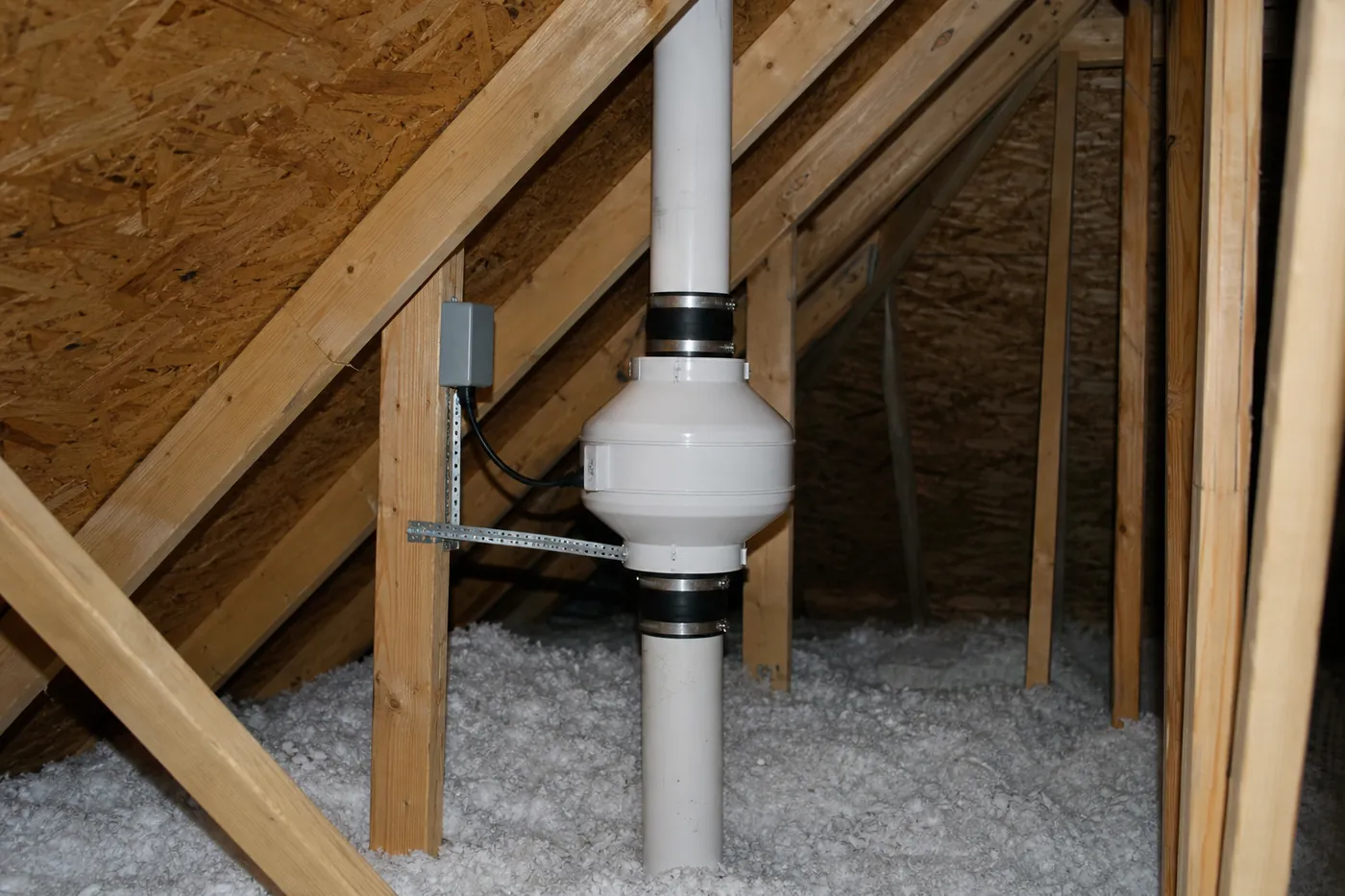
A passive radon system becomes active when a radon fan is added to its vent pipe in the attic, a garage or outdoors, with an alarm or gauge to show it is running. MDH says an active system removes radon better than a passive one. Bob Vila (2022) prices radon fans at $100–$300 or more, before labor and wiring.
Does my house already have a passive radon system?
If it was built in Minnesota after 2009, it should. About 11% of Minneapolis homes were built in 2010 or later (U.S. Census Bureau, 2020–2024), and newer suburbs add many more. Minnesota Rules 1303.2402 leaves clues you can check:
- a 3- or 4-inch PVC or ABS pipe rising from the basement floor, a sump cover or the plastic in a crawl space;
- a label reading "Radon Gas Vent System" on that pipe on each story, in the attic and in crawl spaces;
- the same pipe passing through the attic and ending at least 12 inches above the roof;
- an electrical junction box roughed in near the pipe in the attic, which MDH lists as a standard feature.
What sits under the floor of a radon-resistant home?
A collection layer built for a fan to use later. New floors sit on at least 4 inches of clean aggregate, or sand with drainage matting, covered by 6-mil polyethylene lapped 12 inches at the seams. A "T" fitting under that sheet connects to at least 10 feet of perforated pipe or to the interior drain tile, and its third opening joins the vent pipe. Joints, cracks and floor penetrations are sealed, and a sump basket gets a sealed or gasketed cover (Minnesota Rules 1303.2401 and 1303.2402). Because air moves easily through that layer, MDH's answer to a high result in such a home is to add a fan to the existing pipe.
What kind of fan does Minnesota code require?
- The fan itself: made for radon systems, rated for continuous operation, moving at least 50 cubic feet per minute at half an inch of water column (Minnesota Rules 1303.2403).
- Where it goes: in the vertical vent pipe, outdoors, in the attic or in a garage; never in conditioned space, a basement or a crawl space, and never where it pushes air through pipe inside the living space.
- A warning device: an audible alarm, a manometer or something similar that shows when the fan stops.
- Power and light: a receptacle near the fan and a switch-controlled light fixture, installed under the Minnesota Electrical Code.
- Room to work: the code reserves a clear space 24 inches across and 3 feet tall around the attic pipe for this fan, unless it will sit above the roof with an approved rooftop power supply.
Who can add the fan, and what happens next?
Builders may install radon controls without a radon license until the certificate of occupancy is issued, MDH says. After that, anyone activating the system in a home they do not own or lease needs an MDH mitigation license, and the finished system needs an MDH tag. Retest once the fan has run at least 24 hours. Running costs are small: MDH estimates an active system at slightly more than $14 a year to operate. No national guide we could read prices the labor for an activation on its own, so compare full proposals using what radon mitigation costs in Minneapolis.
Questions homeowners ask
Should I test a newer home that already has a passive radon pipe?
Yes. A passive pipe relies on rising air alone, and MDH says an active system with a fan removes radon better. Only a test shows whether passive venting is keeping your level down. MDH recommends testing every Minnesota home, new or old, and retesting every 2 to 5 years. If the result holds at 4 pCi/L or more, adding a fan is the usual next step.
What is going on with radon at your house?
A test number, a vent pipe with no fan, a gauge that reads level, a closing date: any one of these is enough to start. One independent radon mitigation specialist serving Minneapolis reads it and replies.