Radon System Signs and What They Usually Mean
Radon itself gives no sign at all: no smell, no color, nothing to notice. The equipment that removes it does. Here are the signs worth knowing on a radon system, or on a house without one, each answered first and linked to the page that covers the fix.
Most radon system signs point to the fan. A U-tube gauge reading level, or an alarm sounding, usually means the fan has stopped pulling: check the breaker or plug first, then retest. A system a professional installed after January 1, 2019 with no MDH tag is missing something Minnesota law requires.
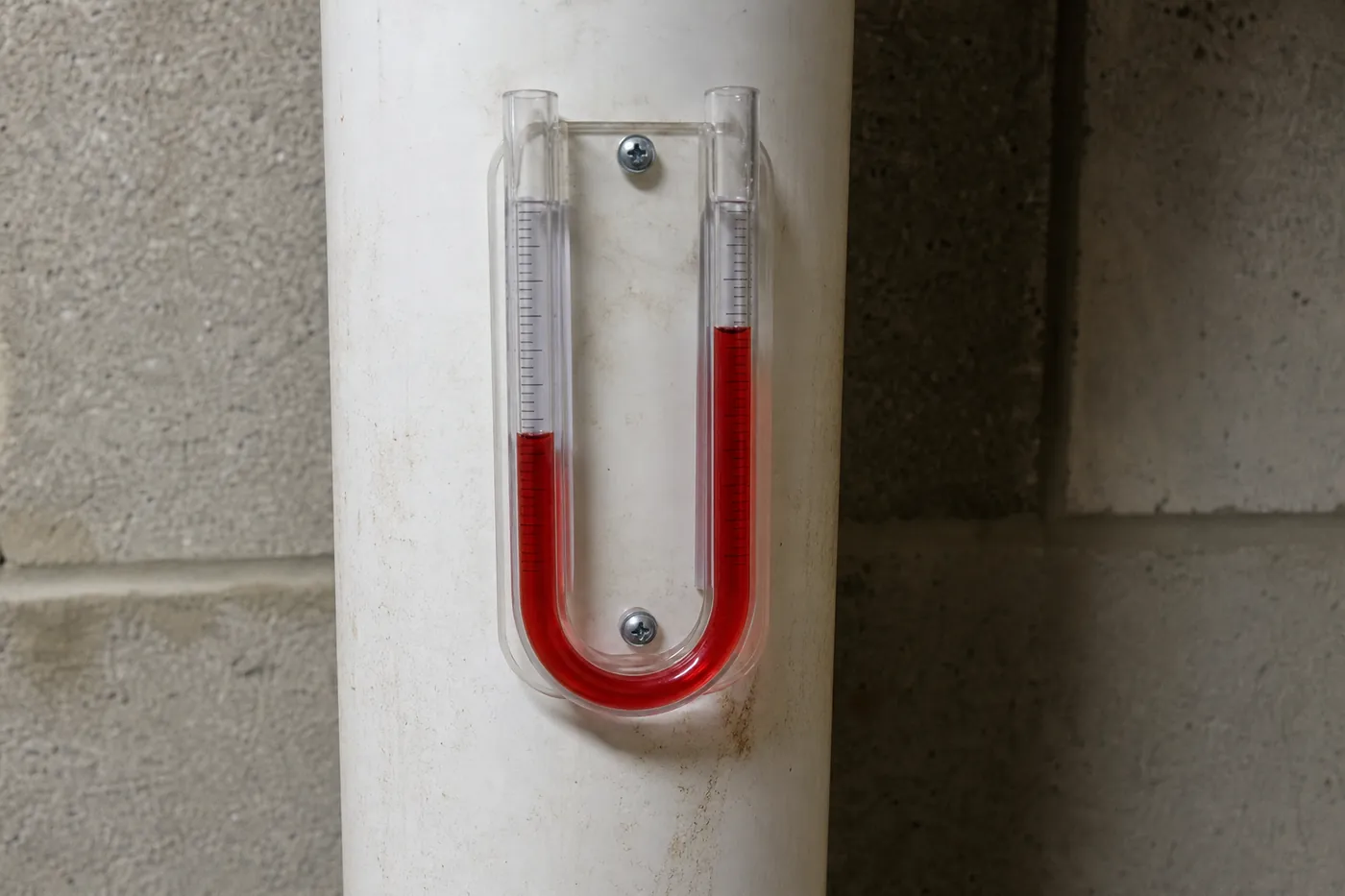
The liquid in the U-tube gauge is level
The fan has probably stopped pulling. A U-tube manometer shows suction as two uneven liquid columns; when both sides sit even, there is no vacuum in the pipe. Check the circuit breaker, the plug or disconnect near the fan, and anything blocking the outlet. If power is fine, the fan likely needs replacing. See radon mitigation in older Minneapolis basements.
The radon alarm is beeping
An active notification monitor sounds when the fan is not working properly, MDH says. Treat it like a level gauge: confirm the fan has power and is turning, then check the manometer. Do not unplug the system to stop the noise, because it is meant to run all the time. If the fan has failed, a replacement and a retest follow.
The fan is louder, rattling or humming
A change in sound usually means a worn bearing, a loose mount or debris in the housing. Radon fans run nonstop, so they do wear out, and Bob Vila (2022) puts a replacement at $100–$300 or more. Have the specialist look at it before it stops outright; the price ranges are in what radon mitigation costs in Minneapolis.
Frost or ice forms at the top of the pipe
Soil gas carries moisture, and with winter averages near 20°F (NOAA) it can freeze where it leaves the pipe. A little frost is common; an ice cap that keeps growing and narrows the outlet is not. Never cover or cap the opening. Minnesota code requires at least R-4 insulation on radon vent pipe that runs through unconditioned space such as an attic (Minnesota Rules 1303.2402). If ice keeps building, ask the specialist to look at the outlet.
Water drips or gurgles inside the pipe
Usually condensation, and usually normal. Damp soil gas cools as it rises and water forms on the pipe walls. Minnesota code requires radon vent pipes to drain back to the ground beneath the floor membrane (Minnesota Rules 1303.2402), so a trickle down the inside is by design. Water leaking out at a joint is not; that joint needs resealing.
There is no MDH tag on the system
If a professional installed it on or after January 1, 2019, it should have one. Minnesota Statutes 144.4961 requires an MDH-issued tag in a visible spot, and MDH says it shows the installer's name, phone, license number and install date. A missing tag on a recent professional job is worth raising with the installer, and with MDH if the work was done by someone without a license.
A pipe goes through the roof but there is no fan
That is a passive radon system, standard in Minnesota homes built since 2009. It vents by rising air alone, with no fan, gauge or alarm. If a test shows 4 pCi/L or more, adding a fan usually comes first; see activating a passive radon system.
The radon result went up after a remodel
Changes in how a house moves air can change its radon level. MDH asks for tests before and after finishing a basement, adding on, replacing windows, adding insulation, installing a kitchen vent hood or changing the heating or cooling system. A higher number after that kind of work calls for a follow-up test, then a system if the result holds at 4 or more. Start with radon testing in Minneapolis.
What is going on with radon at your house?
A test number, a vent pipe with no fan, a gauge that reads level, a closing date: any one of these is enough to start. One independent radon mitigation specialist serving Minneapolis reads it and replies.